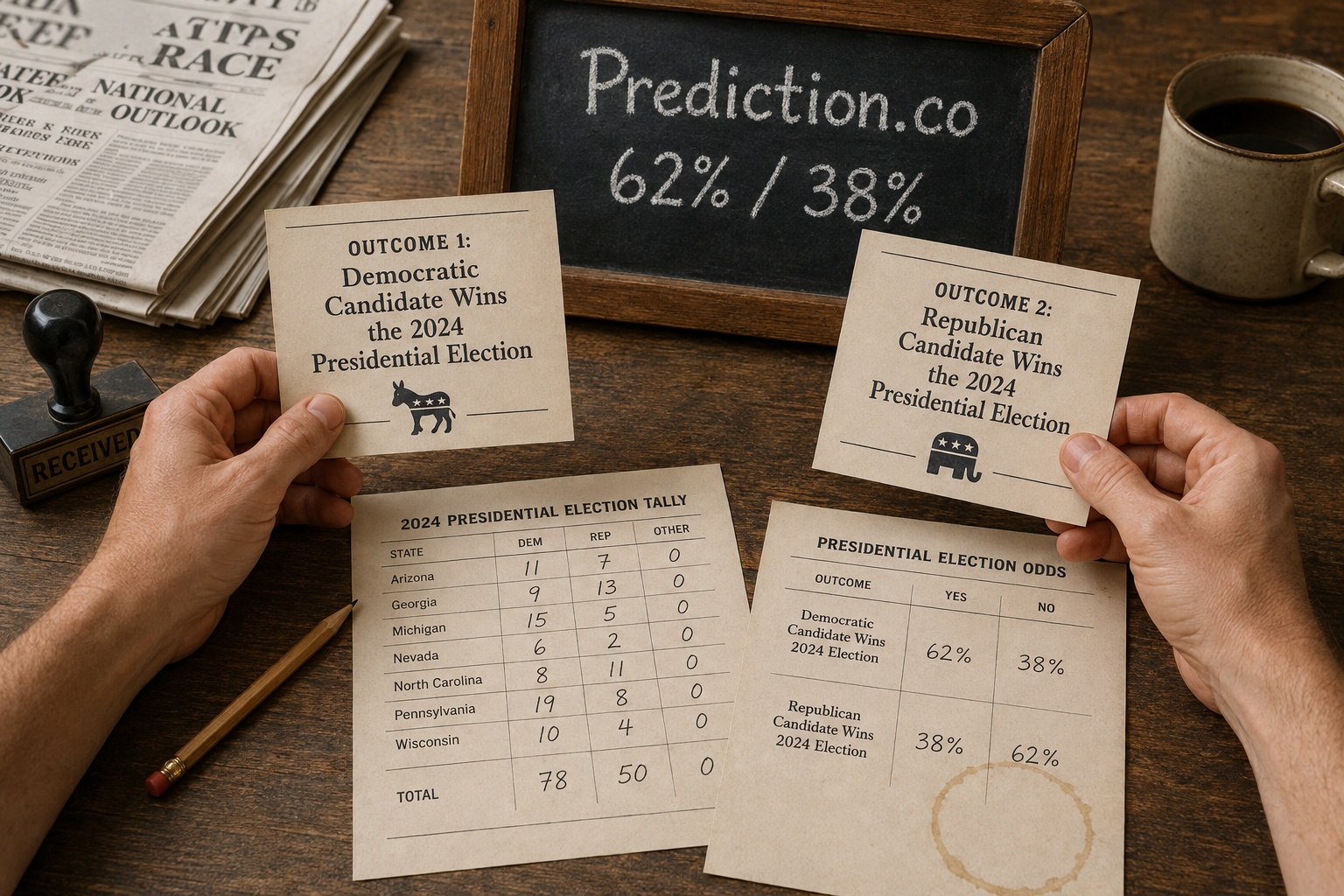
Most forecast products stop at the number. A team sees a 35 percent risk, discusses whether that feels high, and returns to the same question at the next meeting. I think the more useful business for Prediction.co begins one step later. It connects a probability to a decision rule, records the action, and creates a review loop. The product is not there to make the choice. It helps people state what would change their choice and remember why they acted.
That requires a careful boundary. A forecast estimates what may happen under stated conditions. A decision also includes cost, timing, reversibility, responsibility, and values. Two teams can agree on the probability and rationally take different actions because the consequences differ. The interface should preserve that distinction instead of turning every input into a mysterious recommendation score.
Start with a real decision
The setup begins with a sentence: “We need to decide whether to…” The owner enters the deadline, available options, and who is accountable. Next comes the uncertain event that matters. The tool asks for a current probability or range, its source, and the date it was last updated. Only then does the team define thresholds for action.
A threshold makes the conversation concrete. If the risk rises above 40 percent, perhaps the team buys a reversible backup. If it falls below 15 percent, perhaps it keeps the original plan. The tool should ask why those lines exist and show the implied costs on either side. The UK Government Analysis Function uncertainty toolkit includes practical material on analysis and uncertainty, while the NIST risk management resources demonstrate how structured risk thinking can support organizations.
Ranges may be more honest than single numbers. When evidence is thin, a team might record 25–45 percent and identify the missing observation that would narrow it. Prediction.co could display whether the entire range crosses a threshold, just one edge crosses, or neither does. That visual answers a practical question: do we need more information, or is the decision robust to uncertainty?
Keep assumptions beside the forecast
Every estimate carries assumptions. Demand remains steady. A supplier meets its lead time. A public rule does not change. The product should invite teams to name the few assumptions that could reverse the decision and assign an owner to watch each one. When an assumption breaks, the decision page reopens automatically with the original context intact.
Evidence entries should distinguish primary records, informed reporting, internal observation, and judgment. The hierarchy will vary by field, so Prediction.co should not pretend one universal rubric fits every organization. It can require a source, timestamp, owner, and confidence note. Teams can then design stricter templates for their own domain.
The Center for Evidence-Based Management is a useful source for thinking about evidence in organizational decisions, while INFORMS operations-research resources provide a doorway into analytical decision methods. The broader lesson fits the product: quality depends not only on finding material but also on asking whether the evidence applies to this question, this population, and this moment. A source library without that check becomes decoration.
Design for the meeting
I have worked from home for more than twenty years, often across conversations that happen at different times. Important reasoning gets scattered between calls, messages, and documents. A good decision page should survive that fragmentation. Someone joining late can see the question, current forecast, thresholds, assumptions, dissent, decision, and next review date without reconstructing a week of chat.
Before a meeting, participants can enter independent estimates. The product reveals the distribution only after everyone submits, reducing the tendency to anchor on the most senior voice. Large differences trigger a structured discussion: what fact would cause your estimate to move? Which assumption explains the gap? The meeting ends with an owner and review condition rather than a vague agreement to monitor.
Dissent deserves its own field. A participant can record an alternative estimate or objection without blocking the decision. Later, the review can determine whether that dissent identified a real blind spot. This is healthier than rewriting the record until everyone appears to have agreed.
Review outcomes without rewriting history
When the deadline passes, the tool asks three separate questions. Did the forecasted event occur? Was the decision process followed? Given what was knowable at the time, was the action reasonable? A good process can produce a bad outcome, and a careless process can get lucky. Collapsing those cases teaches the wrong lesson.
The review compares forecast and outcome across many decisions, not one dramatic example. It also measures operational habits: how often assumptions were updated, how frequently teams ignored their thresholds, and whether review dates slipped. These signals can reveal a coordination problem even before forecast accuracy becomes statistically meaningful.
Privacy and governance must be designed early. Decision records may contain sensitive plans, employee information, or commercial data. Workspaces need clear access roles, retention controls, exports, and deletion policies. An organization should know where its data lives and whether any automated feature uses it. Prediction.co should be transparent about these choices in language an operating leader can understand.
A focused first product
I would not launch as a universal decision engine. I would choose one repeated workflow with reversible actions and measurable outcomes, then work closely with a handful of teams. The first version needs a decision sentence, probability range, source list, threshold, assumptions, owner, timestamped revisions, and review. Integrations and automated suggestions can wait until the core habit proves useful.
The commercial model follows collaboration. Small teams can use a clear base workspace. Larger organizations may pay for templates, access controls, audit exports, facilitated reviews, and aggregated learning across departments. Consultants can bring a structured room to client engagements without taking ownership of the client’s judgment.
The opportunity is to make uncertain work calmer. People often reach for more data when the real gap is an unstated threshold or forgotten assumption. Prediction.co can keep the forecast visible while reminding everyone that a number is not an action. The product earns trust by preserving the reasoning, the dissent, and the outcome.
That is a substantial role for a simple name. Prediction.co describes the input, but the company’s value would come from the loop around it: estimate, decide, observe, and learn. If the interface helps a team do those four things consistently, it becomes part of how the organization thinks rather than another dashboard it checks.