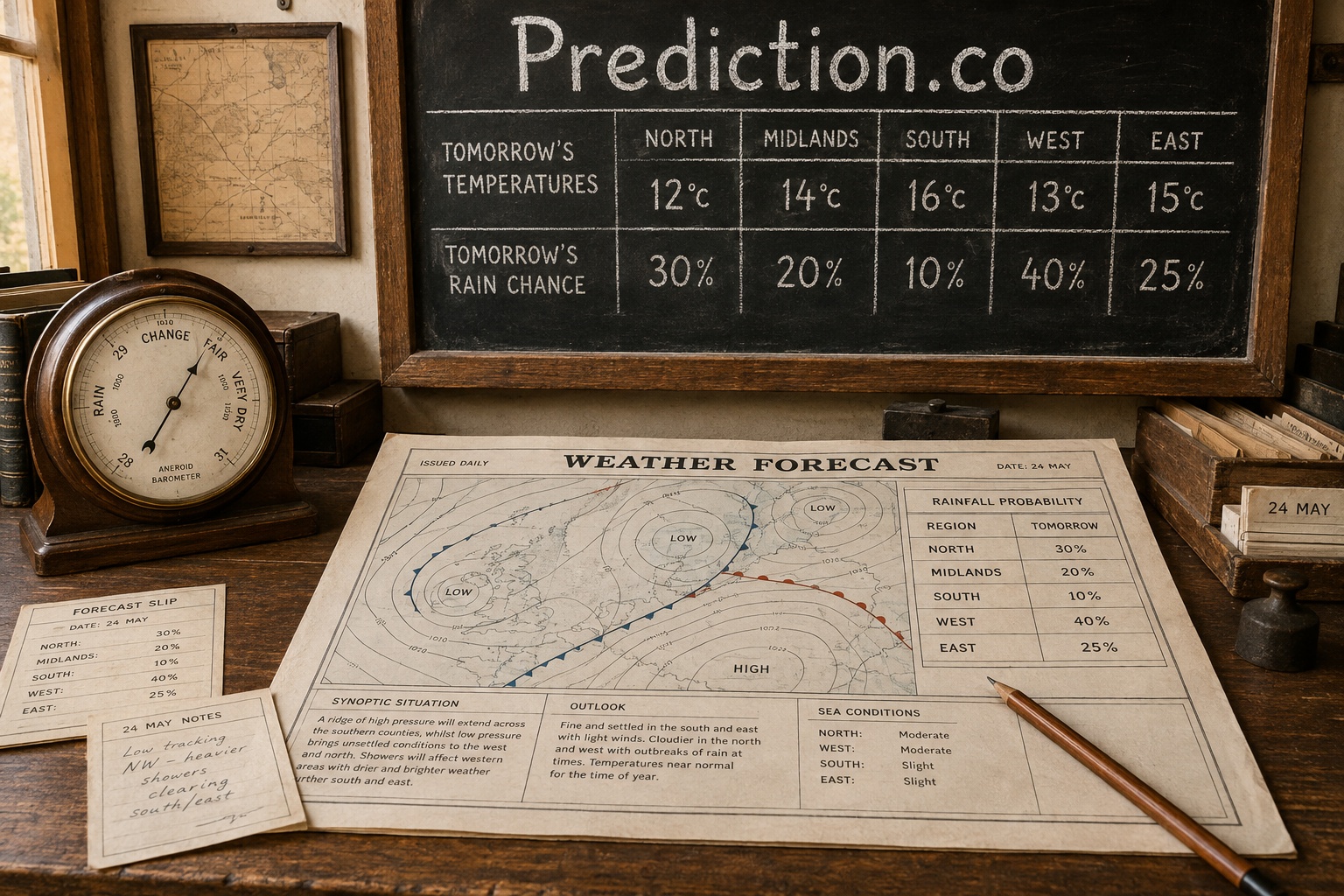
Weather is one of the first places most of us encounter probability in daily life, yet the interface often reduces a complex forecast to an icon and a temperature. I think Prediction.co could support a weather and climate desk whose main product is understanding. It would not try to replace the local forecast people already use. It would explain how confidence changes across hours, days, seasons, and decades, and help readers choose the right forecast for the decision in front of them.
That distinction between horizons is the editorial spine. Tomorrow’s rainfall, next month’s average temperature, and a region’s warming trend are not interchangeable claims. They use different observations, models, baselines, and language. Putting them on one undifferentiated timeline encourages confusion. A serious desk should make the horizon explicit before it shows the answer.
Begin with the reader’s decision
I work from home and have a preschool-age son, so weather questions are rarely abstract. Is the morning dry enough for a playground trip? Should a school event move indoors? Is weekend travel likely to be disrupted? Those are small decisions, but they reveal what a useful page must do: give the time window, location, plausible range, and update cadence without pretending the atmosphere signed a contract.
The desk could organize common decisions into cards. “Leave now or wait?” emphasizes the next two hours. “Plan the weekend” highlights uncertainty across several days. “Prepare the property” focuses on low-frequency, high-impact conditions and links to official alerts. A climate page changes scale entirely, comparing a decade or scenario against a stated baseline.
Official sources should sit close to the claim. In the United States, the National Weather Service provides forecasts and warnings, the National Centers for Environmental Information maintains climate records, and NASA’s climate evidence pages explain long-term observations. The World Meteorological Organization’s weather resources add an international doorway. Prediction.co would add editorial structure, definitions, and comparison—not obscure where the underlying information came from.
Show how a forecast ages
A weather forecast is a versioned object. The Tuesday view of Saturday should remain available after the Thursday update. Readers could see the cone narrow, timing shift, or confidence fall. An annotation might say that the path moved because a front slowed or new observations changed the model spread. Even when the technical explanation must stay brief, showing the revision teaches more than silently replacing the icon.
For routine days, the page should be calm. For significant weather, it should become more disciplined rather than more theatrical. Put official watches and warnings first. Timestamp every update. Separate observed conditions from projections. State the geographic limit. Link to emergency guidance when appropriate. Avoid headlines that turn uncertainty into suspense.
Verification belongs on the page too. The desk can compare forecast ranges with observed outcomes and publish monthly reliability notes. Temperature, precipitation, wind, and storm tracks require different measures; a single “accuracy” badge would mislead. A methods page should explain what gets scored and what does not, and why a useful warning can still describe an event that ultimately misses one neighborhood.
Give climate coverage its own grammar
Climate reporting often fails when a long-term signal is narrated like tomorrow’s weather or a single day is treated as a verdict on a trend. Prediction.co could build a visual grammar that prevents that category error. Weather pages use hours and days. Seasonal outlooks use ranges and historical terciles. Climate pages show baselines, distributions, scenario assumptions, and long records.
The editorial desk could publish a recurring “forecast horizon” column. One edition might follow how El Niño information moves from observation to seasonal outlook. Another could explain why a city-level projection carries different uncertainty than a global average. The point is not to manufacture a weekly revelation. It is to create a library people can return to when a confusing claim enters the news.
Local voices matter. A national model may identify the hazard while a regional meteorologist understands terrain, infrastructure, and communication habits. Partnerships with local forecasters, universities, or public agencies could make the product more grounded. Their role and source should be clear. Prediction.co should be a generous index of expertise, not a brand that implies it invented the weather.
A measured commercial model
The public layer should remain useful without registration: current explainers, source links, revision histories, and essential risk information. A paid professional layer could offer saved locations, configurable briefing windows, team notes, or exportable forecast comparisons for organizations that plan field work and events. Sponsorships would need a visible wall between commercial support and forecast judgment.
There is an opportunity for a morning briefing that respects attention. Instead of summarizing every condition, it could identify what changed since yesterday, what decision window matters, and when the next meaningful update is expected. A user should be able to read it in two minutes and understand both the forecast and its limits.
The name helps because it does not lock the business into a single data source or medium. Prediction.co can be a desk, a briefing, a visual tool, and a methods library. But the name also raises the bar. A category domain should not offer a prettier icon with the same ambiguity underneath.
I would launch in one region with three horizons: the next 24 hours, the next seven days, and a monthly climate context page. The team would test whether readers can correctly describe the confidence after using each page. Interviews should focus on decisions people actually made, not whether they liked a chart. If the product improves comprehension, expansion follows naturally.
The best version is a place that makes uncertainty feel navigable. It would preserve official authority, give revisions a visible history, and use the right language for each horizon. Prediction.co becomes valuable not by claiming the weather is simple, but by helping people see exactly where the forecast is strong and where patience is the wiser tool.